Cross-Cutting Challenge | Touch, Embodiment, and Multisensory Future
Sunday, March 29, 2:00 p.m. - 5:30 p.m.
Last updated: March 29 , 2026.Organizers

Kolding School of Design

University of Miami
Stanford University
Description
Touch is the first sense we develop and, often, the last we lose. It anchors us in the world, grounding memory, emotion, and embodied presence. More than a channel for perceiving and responding to our environment, touch is a fundamental mode of knowing - a bridge between the self and the world. Yet, in our current digital era of modern society, the haptic and tactile dimensions of experience remain underexplored and largely overshadowed by visual and auditory paradigms, placing us at risk of moving toward an increasingly disembodied digital age. As the Finnish architect Juhani Pallasmaa wrote in the initial wave of digital transformation in 1996; “The world of touch is largely unconscious and forgotten, yet it is the sense that integrates our experience of reality and of ourselves” We are led to question: How might haptic technologies shape our sensory and tactile connections in digital futures, and influence our very perception of reality?
This Cross-Cutting Challenge brings together perspectives from design, cognitive sciences, psychology, Human-Computer Interaction (HCI), haptics research, and emerging technologies such as extended reality and artificial intelligence. Exploring how physically embodied interventions can transform digital spaces. It is about identifying underexplored opportunities for haptic applications and investigating the psychological effects of haptic experiences across contexts, from education to emotional connection and well-being. We aim to re-centre touch as a vital dimension of immersive experiences, asking: How can haptics move beyond technical novelty to become a medium of care, learning, and human connection? Highlighting haptics as a pathway for more human-centred and future-oriented approaches, inviting cross-disciplinary dialogue on how we design touch in our digital era for meaningful impact.
The motivation behind this Cross-Cutting Challenge is twofold:
(1) to bridge disciplinary silos by connecting researchers and practitioners who investigate haptics from diverse perspectives and fields, addressing the challenge of how haptic research can support positive societal change.
(2) to articulate how tactile and sensory interventions can transform our digital spaces and how multisensory experiences can be integrated into different environments, designing hybrid environments where physical and digital interactions converge and how we can ensure these technologies are developed inclusively and responsibly.
By engaging these themes and questions across disciplines, this CCC seeks to advance a collective vision of haptics not as an isolated technical feature, but as a transformative modality for future applications and multisensory experiences. This CCC session invites us to reflect on the challenge of the shifting role of immersive and multisensory experiences as both a scientific frontier and a human-centred practice. Through open discussions, keynote talks and live demo sessions, this session offers new knowledge on how haptic research can inform and shape ethical, inclusive, and adaptive multisensory futures, fostering the understanding that haptics is not merely a matter of feedback, but a relational practice, linking body and world, and bridging knowledge across disciplines.
Session Program
2:00 p.m. – 2:10 p.m.
Welcome and Opening Remarks
Topaz 2
Introduction to the session and overview of the program.
2:10 p.m. – 3:00 p.m.
Keynote Session
Topaz 2
Keynote presentations exploring key perspectives related to the conference theme. Each presentation includes time for Q&A.
3:00 p.m. – 3:30 p.m.
Coffee Break
Gallery Foyer
An opportunity for informal networking and conversation.
Transition to Panel Session
3:35 p.m. – 4:15 p.m.
Panel Presentations
Topaz 2
Four invited speakers will present short perspectives (10 minutes each) addressing the session topic from different disciplinary viewpoints.
4:15 p.m. – 4:30 p.m.
Panel Discussion
Topaz 2
Moderated discussion with the panel speakers, including Q&A.
4:30 p.m. – 5:30 p.m.
Poster and Demo Session
Sage
Attendees are invited to explore posters and demonstrations and engage in informal discussions with presenters.
Keynote Speakers

Abstract:
The seamless manipulation of hand-held objects in Virtual Reality (VR) relies heavily on two often competing requirements: input tracking with high freedom of movement, and high-fidelity haptic feedback. Traditionally, the field has leaned toward complex hand exoskeletons and gloves that attempt to render forces on a meticulous, finger-by-finger basis. In this talk, we present an alternative set of haptic devices with a pragmatic approach focused on rendering the object properties rather than matching the hand mechanics.
Biography:
Mar Gonzalez-Franco, PhD, is a Computer Scientist and Neuroscientist at Google working on a new generation of Immersive technologies. With a background in real-time systems in her research she tries to build better interactions for immersive technologies using different disciplines: Virtual Reality, Augmented Reality, AI, computer graphics, computer vision, Avatars, and haptics. All while studying human behaviour, perception and neuroscience. She was awarded the 2022 IEEE VGTC VR New Researcher Award, and the NAE Frontiers Engineer. She leads the BIRD lab, working on Blended Interactions Research and Devices.
https://research.google/people/108218/?&
/
https://www.linkedin.com/in/margonzalez/

Abstract:
In everyday life, we interpret haptic sensations within rich multimodal context alongside visual, auditory, and other sensory cues. Yet designing expressive and intuitive haptic experiences that align with this sensemaking remains more craft than science, often requiring years of tacit expertise and trial and error. In this talk, I present research from my lab exploring computational approaches to supporting haptic design. By systematically collecting data on users’ haptic language and cross-modal experiences, we model how people perceive, describe, and translate haptic feedback across modalities. I conclude by discussing future directions for how such data-driven methods can help designers move beyond intuition toward principled tools for creating expressive, context-aware haptic interactions.
Biography:
Hasti Seifi is an assistant professor in the School of Computing and Augmented Intelligence at Arizona State University. Her research lies at the intersection of human-computer interaction, haptics, social robotics, and accessibility, with a focus on designing expressive and meaningful touch interactions. Her work has been recognized with several awards, including an ACM SIGCHI Special Recognition (2025), the NSF CAREER Award (2024), and the EuroHaptics Best Ph.D. Thesis Award (2017). Hasti serves the HCI and haptics communities in various roles, including Subcommittee Chair for ACM CHI (2025, 2026) and Program Co-Chair for EuroHaptics 2022.
Panel Speakers
Biography:
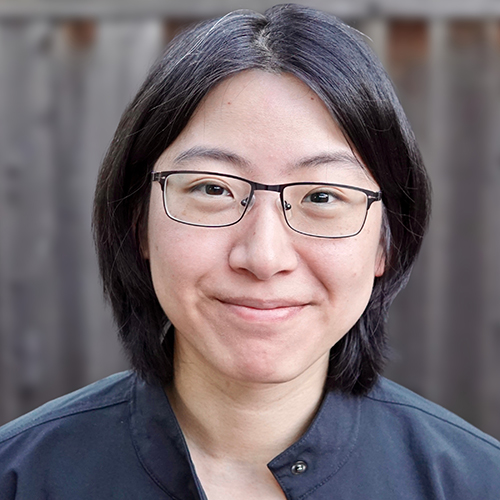
Ava Chen is a Postdoctoral Scholar in the Collaborative Haptics and Robotics in Medicine Lab at Stanford University, advised by Allison Okamura. She received her Ph.D. in Mechanical Engineering from Columbia University under Matei Ciocarlie. Her research explores how robotic garments can assist and study human sensorimotor coordination in the contexts of manipulation, rehabilitation, and shared autonomy. She is a recipient of the Ruth L. Kirschstein National Service Award (NIH F31), Robotics: Science and Systems Pioneer, and ME Rising Star.
Biography:
Marie P. P. M. Holm is an MA Danish Design student at Kolding School of Design, currently completing her master’s thesis. She holds a BA in Textile Design and has recently been a Visiting Research Scholar at the University of Miami’s Department of Interactive Media. Her design research investigates tactility, haptics, and embodied perception in XR, with particular focus on haptic gloves and multisensory interfaces across care and educational contexts. Grounded in sensory design practice and human-centred design, her work explores how immersive technologies can support cognitive, emotional, and socially sustainable futures.

Biography:
Elyse D. Z. Chase is a Rice Academy Fellow at Rice University and was previously an Intelligence Community Postdoctoral Fellow. Her research focuses on multisensory feedback, particularly haptics, and how touch, vision, and action jointly shape human learning, control, and collaboration with intelligent systems. She has a B.S.E. in Mechanical Engineering and Applied Mechanics from the University of Pennsylvania, and an M.S. and Ph.D. in Mechanical Engineering from Stanford University.
Biography:
Yujie Tao is a Ph.D. student in Computer Science at Stanford University, specialising in human–computer interaction. She is a member of the SHAPE Lab, advised by Prof. Sean Follmer, and collaborates closely with Prof. Jeremy Bailenson at the Virtual Human Interaction Lab. Her research explores how computing systems can reconnect users to everyday interactions through interfaces that augment human perception, enabling new ways of engaging with the world. She received her MS from the University of Chicago under the advisement of Prof. Pedro Lopes and holds a BA from UNC-Chapel Hill with a double major in Journalism and Computer Science.
Poster and Demo Presenters
Posters
| Towards Human-Centered Teleoperation Through Learning-based Shared Autonomy Control | |
| Cross-Disciplinary Perspectives on the Human Experience of Embodied Interactions | |
| From Structure to Emergence: Democratizing Experience in Transdisciplinary Haptics Research | |
| Deconstructing the Multisensory Experience: A Multidimensional Investigation of Neural Haptics in Embodied Interaction | |
| Subjective Qualities of Virtual Walls with a Damped Boundary Region | |
Demos
| LexiLearn: Multisensory AI-enhanced Virtual Reality Integration for Literacy Skills Acquisition | |
| HeatFlow: A Thermal-Tactile Display for Dynamic 2D Thermal Movements (UIST 2025, Best Paper Honorable Mention Award) | |
| SensoryBlox: Plug-and-Feel Modular Multi-Sensory User Interfaces for Immersive Cardboard VR (to be presented at CHI 2026) | |
| Title: Twin-system Haptic Sensing+Feedback Gloves and Multipoint Fabric Tactors | |
Call for Individual Contributions
We invite attendees to contribute to this Cross-Cutting Challenge through poster or demonstration submissions, which will be presented in an interactive session designed to foster dialogue, exchange, and hands-on engagement. This session aims to create an open and inclusive space where diverse perspectives and approaches to haptics can be shared, discussed, and experienced, supporting cross-disciplinary learning and expanding how we collectively understand touch as a meaningful modality in digital futures.
Submissions may address, but are not limited to, topics such as embodied interaction, multisensory experience design, psychological or emotional effects of haptics, hybrid physical and digital environments, care, learning, well-being, or critical and speculative approaches to touch in digital systems.
To submit a poster or demonstration proposal, please send the following information in a single email:
- Title
- Abstract (max. 500 words) The abstract should clearly outline how your work in haptics connects to the themes of this CCC.
- Presentation format: Poster or Demonstration
Email subject line: CCC Demo Proposal: IEEE Haptics Symposium 2026
We particularly encourage submissions from contributors with disciplinary backgrounds that are currently underrepresented in the haptics community, including but not limited to design, art, architecture, humanities, social sciences, healthcare, education, and creative practice. Both theoretical and practice-based work are welcome.
Please submit your proposal by February 1, 2026, by emailing the organisers ( 2021b067@dskd.dk , aqueiroz@miami.edu ).